Traverse SWCD Board Supervisor’s Farm Achieves Water Quality Certification
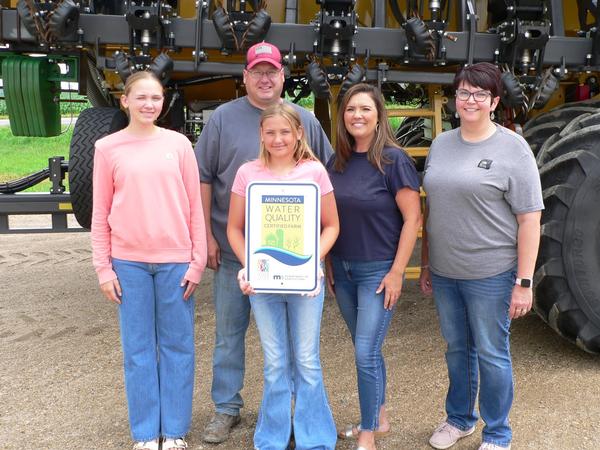
River Bend Ag Partnership, proudly operated by Chester Raguse, has recently achieved water-quality certification under the Minnesota Agricultural Water Quality Certification Program (MAWQCP). This voluntary program certifies producers who use conservation-minded practices to protect water quality by requiring an in-depth examination of field characteristics, crop rotation, tillage, nutrient management, and pesticide management, depending on the operation. Raguse’s farm accompanies over 1,500 producers farming over one million accredited acres throughout the state.
“I read about the program as a Traverse SWCD board supervisor, realizing we implement a lot of the qualifying practices within our operation,” Raguse explained. “And, our farming operation has always been as environmentally sound as possible, so it just made sense to apply.”
Raguse began farming the family operation back in 2000, where corn, soybeans, and alfalfa rotate among approximately 4,500 acres. Both strip and vertical tillage are utilized as residue management tools, while cover crops are planted after corn and soybeans to prevent erosion and promote soil health. Variable Rate Technology (VRT) is also used to apply fertilizer during the planting season.
Cover crops can be defined as any non-cash crop grown to the primary cash crop. These crops have the potential to increase soil organic matter, reduce erosion, improve soil structure, and promote water infiltration. Additionally, as the name suggests, variable-rate fertilizer applications allow producers to apply different fertilizer rates at each location across a given field. This more precise application reduces potential runoff, thereby protecting water quality.
Raguse can also attribute those same benefits – as well as reduced soil erosion – to their adoption of vertical and strip-till across all their corn and soybean rotations. This is because vertical tillage cultivates up to 4 inches without direct inversion, so residue isn’t completely incorporated into the soil, while strip-till minimizes tillage by disturbing only the portion of soil needed to sow seeds.
Overall, because of these best management practices implemented by Raguse, River Bend Ag Partnership officially became water quality certified on July 14, 2026.
“The MAWQCP program requires farmers to follow good conservation practices that improve soil health, which can then help increase profits on the farm,” Raguse said.
Posted in: MAWQCP