Ogema Operation Achieves Water Quality Certification
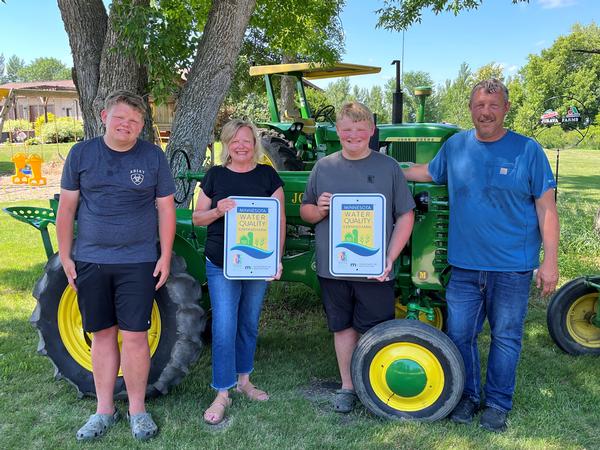
Earlier this year, the Jirava family, consisting of Vance, his wife, Kim, and their two sons, Reed and Colton, joined over 1,500 producers in becoming stewards of water quality through the Minnesota Agricultural Water Quality Certification Program (MAWQCP). This voluntary program through the Minnesota Department of Agriculture certifies farming operations utilizing conservation practices to protect Minnesota’s water resources. Today, the decade-old program has confirmed over one million acres across the state working in conjunction to reduce soil erosion and protect water quality.
“We’re always looking toward the future of agriculture in our area, and this program seemed like a good fit for us,” Kim explained. “The certification has strengthened our farm’s compliance position, opened access to different resources, and shows that we value our local water resources.”
The Jiravas manage a row-crop operation in Becker and Clay Counties where corn, soybeans, and wheat are typically rotated. Conservation tillage is utilized on the majority of these acres as they transition into a no-till operation. By definition, conservation tillage is any tillage that leaves at least 30% residue after planting, whereas no-till is the practice of planting crops without disturbing the soil. The Jiravas will also plant a cover crop mixture consisting of radishes, turnips, and winter rye after soybean or wheat harvests, which helps enrich and protect the soil surface of their fields. Overall, these conservation practices, in combination, help increase soil organic matter, improve soil structure, and reduce soil erosion, thereby protecting surrounding water quality.
“We are moving towards a minimal or no-till operation,” Kim explained. “We also experimented with some cover crops this spring and are hoping to see an improvement in yield and cost savings with herbicide applications.”
Because of the current and future best management practices implemented by Vance and his family, they officially became water quality certified on March 27, 2026.
“This program makes you take a step back and look at different ways to improve your operation,” Kim said. “It also opens the doors to other programs that help you make the most out of the land you farm.”
Posted in: MAWQCP