Gillespie Brothers Earn Water Quality Certification
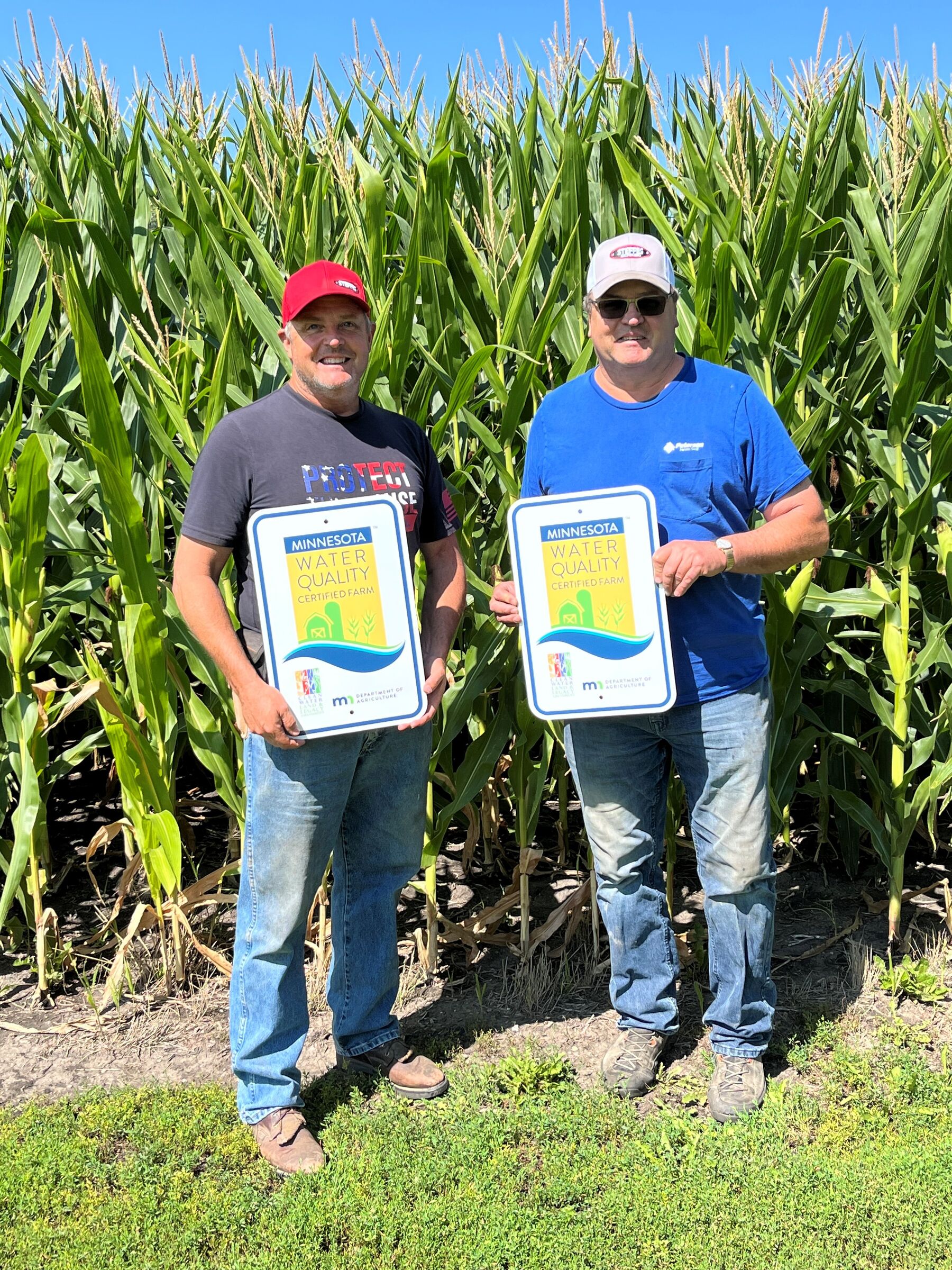
Scott and Curtis Gillespie have joined the rising number of producers becoming water quality certified through the Minnesota Agricultural Water Quality Certification Program (MAWQCP). This voluntary program certifies producers using conservation-minded practices to protect water quality by requiring an in-depth examination of field characteristics, crop rotation, tillage, nutrients, and pesticide management techniques, depending on the operation. For the Gillespie Brothers, using conservation tillage to grow corn and soybeans across 1,400 acres is their primary focus.
“We first became interested in MAWQCP because it aims to help producers take care of their topsoil which is our farm’s primary goal,” Scott explained. “Now our certification reminds us every day of the continued education we need to maintain our goal and live up to the quote, ‘humanity’s existence is based on the top six inches of soil and a little rain.’ In other words, we must save what we’ve got.”
These fourth-generation farming brothers each have three decades worth of experience and are slowly incorporating the knowledge to the next generation of the operation. Both Scott and Curtis are passionate about keeping their topsoil on their land, utilizing cover crops, grass filter strips, field windbreaks, sediment basins, and various forms of conservation tillage to prevent future wind and water erosion.
A grass filter strip is a stretch of land that is permanently vegetated to aid in filtering contaminants of surface water. Similarly, sediment basins function by intercepting runoff, allowing potential soil particles to settle out instead of being discharged into surface water. Meanwhile, cover crops are non-cash crops that can reduce erosion and promote water infiltration whereas field windbreaks are closely spaced trees and shrubs planted specifically to reduce wind erosion and improve water efficiently.
Additionally, because of Traverse County’s heavy soil, drainage management is an important factor for the Gillespie brothers too in order to keep both their soil and crops healthy. One way they are doing this is replacing their surface inlets with French drains to help their fields become less saturated during the growing season.
“It’s hard to work on soil health when it’s always saturated,” Scott said. “We’re hoping to improve our acres by focusing on the conservation practices we know work on our farm. Good soil means healthy crops, which also means nothing is being sent downstream.”
Overall, because of these best management practices implicated by the Gillespie brothers, both Scott and Curtis became certified water quality producers on August 3, 2026.
“The Ag community has to collectively do a better job for the land and environment and showcase how we do it,” Scott said. “It’s also important to demonstrate to farmers and non-farmers alike of the deep connection ag producers have with their land – and it’s not something that’s financially intertwined.”