Erhard Producer Receives Water Quality Certification
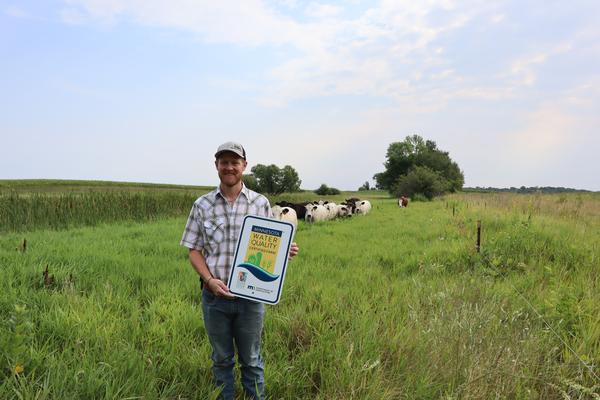
Landon Ohe has joined the rising number of producers becoming water-quality certified through the Minnesota Agricultural Water Quality Certification Program (MAWQCP). This voluntary program certifies producers who use conservation-minded practices to protect water quality by requiring an in-depth examination of field characteristics, crop rotation, tillage, nutrient management, and pesticide management, depending on the operation. Ohe’s farm achieved certification in July of 2026, joining over 1,500 producers farming one million accredited acres throughout the program.
“I originally heard about MAWQCP from attending soil health conferences,” Ohe said. “The certification is rewarding because it shows that I am raising crops and cattle responsibly, which is important since I’m close to cherished lake areas.”
Ohe is the sixth-generation farmer tied to the approximate 350-acre operation where corn, soybeans, wheat, alfalfa, and a multispecies of annual forages are grown while cow/calf pairs and steers for direct marketing beef are rotationally grazed. On his cropland, Ohe practices no-till or strip-till, depending on the crop and cover crops, to help extend the grazing season for his herd.
“The conservation practices MAWQCP requires align with how I raise my livestock and crops,” Ohe explained. “Which gives me confidence in knowing that I am doing the right things to produce quality beef for my community and protect the land it’s grown on.
Rotational grazing is a practice that involves moving livestock to different paddocks to encourage recovery of previously grazed vegetation; cover crops are any non-cash crop grown to the primary cash crop; and no-till is a technique for growing crops or pastures without disturbing the soil through tillage. Overall, all these management types help prevent soil erosion while promoting water quality throughout Ohe’s farming operation.
In the future, Ohe hopes to continue fine-tuning the practices that contribute to soil health on his land. He would also like to advance his grazing management to become a low-input system that does not require or rely on outside resources.
“If we want to pass down land to future generations,” Ohe said, “we need to continue to protect our soil and water resources, and MAWQCP can help steer those in the right direction.”